
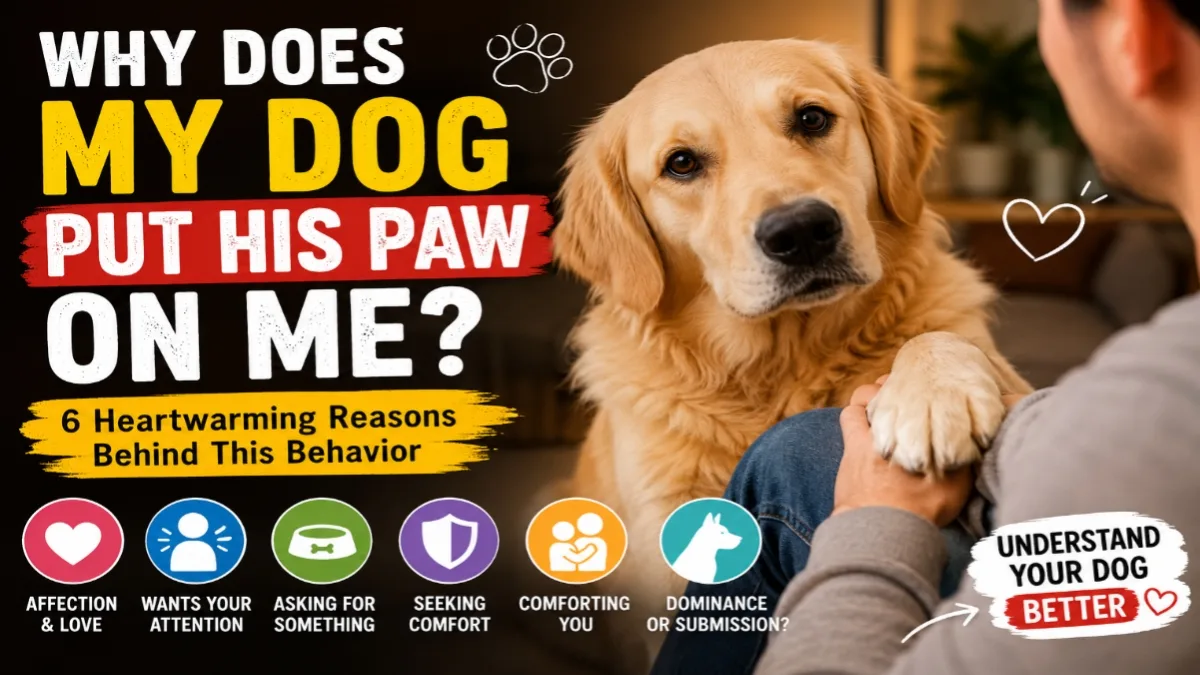

Have you ever been sitting on the couch, working on your laptop, or relaxing in bed when your dog quietly walks over and gently places a paw on your arm, leg, or hand?
It’s one of those small moments that instantly melts a dog owner’s heart. But after the initial “aww” moment, many people start wondering, “Why does my dog put his paw on me?”
The answer isn’t always the same.
Sometimes it’s your dog’s way of saying “I love you.” Other times, they’re asking for attention, reminding you it’s dinner time, or looking to you for comfort when they feel nervous.
Dogs don’t communicate with words the way humans do. Instead, they rely on body language, eye contact, facial expressions, posture, vocal sounds, and physical touch to express what they’re feeling. A gentle paw on your hand is one of the clearest forms of canine communication.
Understanding why does my dog put his paw on me can help you recognize your dog’s emotions, strengthen your relationship, and know when the behavior is perfectly normal—and when it may indicate stress or anxiety.
In this guide, you’ll discover the six most common reasons dogs place their paws on people, what each behavior usually means, and how to respond in a way that builds trust with your pet.
Veterinary behavior experts also recommend looking at your dog’s complete dog body language rather than judging a single action. A relaxed tail, soft eyes, loose posture, and calm breathing together tell a much more accurate story than one behavior alone.
The Science Behind Why Dogs Use Their Paws to Communicate
Unlike people, dogs don’t have words to express emotions or needs.
Instead, they communicate through a combination of:
- Eye contact
- Tail movement
- Ear position
- Facial expressions
- Vocal sounds
- Physical touch
A paw placed on your hand is often the canine equivalent of tapping someone gently on the shoulder.
For dogs, physical contact strengthens social bonds. Puppies touch their mother and littermates constantly during their first weeks of life. As adult dogs, many continue using gentle touch to communicate with the people they trust most.
Researchers studying the human-dog relationship have also found that positive interactions—including gentle physical contact—can increase oxytocin, often called the “bonding hormone,” in both dogs and humans.
That means a simple paw on your arm isn’t always asking for something.
Sometimes it’s simply your dog’s way of feeling connected to you.
1. Your Dog Is Showing Affection
The most common answer to why does my dog put his paw on me is surprisingly simple.
Your dog loves you.
Many dogs naturally seek physical contact with the people they trust most. Just as humans hug family members or hold hands with loved ones, dogs often express affection through gentle touch.
If your dog calmly walks over, looks at you with relaxed eyes, and softly places a paw on your hand while resting beside you, they’re usually saying:
“I feel safe with you.”
This behavior is especially common after:
- Cuddling together
- Quiet evenings on the couch
- Relaxing before bedtime
- Receiving pets or belly rubs
Signs your dog is simply showing affection include:
- Soft eyes
- Relaxed ears
- Loose body posture
- Gentle tail wagging
- Quiet behavior without whining
In these situations, the paw is less about asking for something and more about maintaining a close emotional connection.
Many owners never realize that such a small gesture can be one of the strongest signs of trust a dog can give.
2. Your Dog Wants Your Attention
Another very common reason your dog puts a paw on you is because they’ve learned it gets your attention.
Think about what usually happens after your dog places a paw on your arm.
Do you smile?
Do you pet them?
Do you talk to them?
Do you stop looking at your phone?
If the answer is yes, your dog has already figured something out:
“When I touch my human with my paw, they pay attention to me.”
Dogs are excellent at learning which behaviors bring positive results. If placing a paw on you has earned them attention in the past, they’re likely to repeat it whenever they want interaction.
This isn’t manipulation—it’s simply how dogs communicate.
They may be asking for:
- Belly rubs
- Playtime
- A cuddle
- Conversation
- Eye contact
- A little extra affection
Many dogs do this when they notice you’re busy working, watching television, or scrolling through your phone. Instead of barking or jumping, they choose a calm and polite way to say:
“Hey… don’t forget about me.”
Signs your dog simply wants attention
- They place one paw on you and wait.
- Their tail wags gently.
- They maintain soft eye contact.
- They become excited once you respond.
- They stop pawing after receiving attention.
This type of behavior is completely normal and usually reflects a healthy relationship between you and your dog.
Also Read: If you’re learning how dogs communicate through body language, don’t miss our guide on Dog Sleeping Positions Meaning, where we explain what different sleeping postures reveal about your dog’s emotions and comfort level.
3. They’re Asking for Something
Sometimes the answer to why does my dog put his paw on me is much more practical.
Your dog isn’t asking for affection.
They’re making a request.
Dogs quickly learn daily routines. They know when it’s breakfast time, when you normally go for walks, or when it’s time to play.
If you’re running late or distracted, your dog may gently remind you by placing a paw on your leg.
Watch what happens immediately afterward.
Many dogs will:
- Look toward their food bowl.
- Walk to the front door.
- Pick up their leash.
- Bring you a favorite toy.
- Stand beside the treat cabinet.
The paw isn’t the entire message.
It’s simply the first part of their communication.
The rest of their body language tells you exactly what they’re asking for.
Common things your dog may be requesting
- Breakfast or dinner
- A walk outside
- Fresh drinking water
- Playtime
- Bathroom break
- Their favorite toy
Dogs thrive on routine, so this behavior often appears around the same time every day.
Rather than barking continuously, many dogs discover that a gentle paw works much better.
That’s one reason so many owners describe it as one of the politest ways dogs communicate with humans.
4. Your Dog Is Looking for Comfort and Security
If your dog places a paw on you during a thunderstorm, fireworks, or any unfamiliar situation, they may be looking for reassurance rather than attention.
Dogs naturally turn to the people they trust when they feel uncertain or anxious. For many pets, their owner represents safety.
A gentle paw can be their way of saying:
“I don’t feel comfortable right now. Can you stay with me?”
This behavior is especially common in dogs that become nervous around:
- Loud thunder
- Fireworks
- Vacuum cleaners
- New environments
- Veterinary visits
- Strangers entering the home
When a dog is seeking comfort, the paw is usually accompanied by other body language signals.
Signs your dog wants reassurance
- Ears pulled back
- Tail tucked or held low
- Lip licking or yawning
- Staying very close to you
- Leaning against your body
- Soft whining
Instead of forcing your dog to “be brave,” calmly reassure them with your presence and a gentle voice. Creating a safe environment helps reduce anxiety over time.
5. They’re Comforting You
Dogs don’t just understand their own emotions—they’re also surprisingly good at recognizing ours.
Research suggests that dogs can detect changes in human facial expressions, tone of voice, and even body language. Many owners notice that their dog behaves differently when they’re feeling sad, stressed, or upset.
If your dog quietly walks over, sits beside you, and places a paw on your hand while you’re having a difficult day, they may actually be trying to comfort you.
This is one of the strongest examples of the emotional bond between dogs and humans.
Research also suggests that dogs are highly responsive to human emotions and body language. If you’d like to learn more about canine behavior and communication, the Merck Veterinary Manual’s Dog Behavior guide provides detailed veterinary information.
Signs your dog is comforting you
- They stay unusually close.
- They gently rest a paw on your arm or leg.
- They lick your hand or face.
- They remain calm instead of asking to play.
- They watch your face closely.
While scientists are still studying canine empathy, many animal behavior experts believe dogs can respond to human emotional changes through observation and learned social bonding.
For many pet owners, this gentle paw feels like their dog’s silent way of saying:
“I’m here with you.”
Related Article: If your dog suddenly becomes energetic after bath time, read our guide on Why Do Dogs Zoom After a Bath? to understand the science behind FRAPs (Zoomies) and post-bath behavior.
Could It Ever Be a Sign of Dominance?
Years ago, many people believed that when a dog placed a paw on its owner, it was trying to become the “alpha” or dominate the household.
Modern canine behavior research tells a different story.
In most family dogs, putting a paw on someone is rarely about dominance. It’s much more likely to be a form of communication, affection, or a request for attention.
However, context always matters.
If your dog shows other concerning behaviors along with forceful pawing, it may be worth speaking with a qualified dog trainer or veterinary behaviorist.
Warning signs that deserve attention
- Stiff body posture
- Direct, hard staring
- Growling while pawing
- Guarding food or toys
- Snapping when touched
- Repeated forceful pawing that ignores your response
These behaviors are not typical signs of affection and should be evaluated as part of your dog’s overall body language—not just the paw itself.
For the vast majority of dogs, though, a gentle paw simply means they want to connect with you.
Quick Guide: What Does It Mean When Your Dog Puts a Paw on You?
| Dog’s Behavior | Possible Meaning | What You Should Do |
|---|---|---|
| Gentle paw with relaxed eyes | Affection and trust | Pet your dog and enjoy the moment |
| Paw while you’re busy | Wants your attention | Spend a few minutes interacting |
| Paw followed by looking at the door | Wants a walk | Take them outside if it’s time |
| Paw near the food bowl | Hungry or asking for water | Check their routine |
| Paw during thunderstorms | Seeking comfort | Stay calm and reassure your dog |
| Forceful pawing with growling | Possible behavioral issue | Consult a veterinarian or certified trainer |
Conclusion: Why Does My Dog Put His Paw on Me?
If you’ve ever wondered why does my dog put his paw on me, the answer is usually simple: your dog is trying to communicate.
A gentle paw can express love, trust, comfort, curiosity, or a simple request for your attention. It’s one of the sweetest ways dogs strengthen their bond with the people they care about most.
Learning to read your dog’s body language helps you understand not only what they need, but also how deeply they trust you.
The next time your furry friend quietly places a paw on your arm, don’t ignore the moment.
It may be their own silent way of saying,
“You’re my favorite person.”
Faq
Why does my dog put his paw on me?
Most dogs place a paw on their owner to show affection, seek attention, ask for something, or strengthen their emotional bond.
Is it a sign of love when my dog puts a paw on me?
Yes. In most cases, a gentle paw is a sign of trust, affection, and love. Dogs often use physical touch to communicate with the people they care about.
Why does my dog put his paw on me while I’m petting him?
Your dog may be asking you to continue petting them or returning your affection. It’s often a positive social behavior.
Should I ignore my dog’s pawing behavior?
Not always. Gentle pawing is normal, but constant pawing may indicate your dog needs attention, food, a walk, or feels anxious. Understanding the situation is important.
Can putting a paw on me be a sign of dominance?
Usually no. Modern canine behavior experts believe that pawing is more commonly linked to communication and affection than dominance.