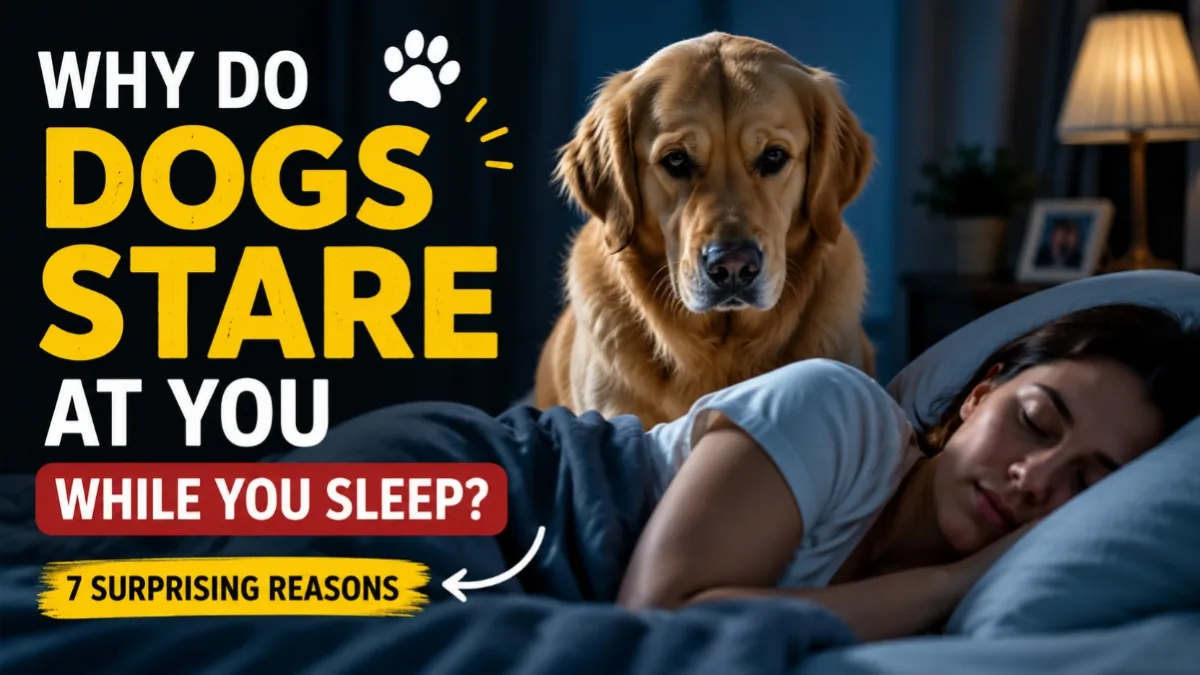

Have you ever woken up in the middle of the night only to find your dog quietly staring at your face?
It can feel a little strange at first. Your dog is sitting just a few inches away, watching you without making a sound. Naturally, you might wonder, “Why do dogs stare at you while you sleep?”
The good news is that, in most cases, this behavior is completely normal.
Dogs don’t look at us the same way humans look at each other. They rely on eye contact, body language, scent, breathing patterns, and daily routines to understand what’s happening around them. While you’re asleep, your dog is still gathering information about you and your environment.
Understanding why do dogs stare at you while you sleep can help you better understand your pet’s emotions, strengthen your bond, and recognize when a behavior is simply affectionate—or when it might need a little more attention.
In this guide, you’ll learn the seven most common reasons behind this behavior, what it says about your dog’s emotional state, and when it’s worth speaking with your veterinarian.
Veterinary behavior experts generally agree that a dog’s behavior should never be judged by one action alone. Looking at several **dog body language **signals together gives a much clearer picture of how your dog is feeling.
The Science Behind Why Dogs Watch Their Owners Sleep
Before looking at the specific reasons, it’s helpful to understand how dogs see the world.
Unlike humans, dogs don’t rely mainly on vision. They constantly combine scent, hearing, movement, and routine to understand what’s happening around them. Even while you’re asleep, your breathing changes, your body shifts position, and your scent naturally changes throughout the night.
Because of this, dog sleep behavior is often closely connected to the behavior of the people they trust the most.
Many dogs simply enjoy keeping an eye on their favorite person.
Others are waiting for signs that you’re about to wake up.
Some are quietly making sure everything around the house is safe.
This is why staring isn’t automatically a sign that something is wrong.
1. Your Dog Is Watching Over You (The Guardian Instinct)
One of the most common reasons behind **why does my dog watch me sleep **is an instinct that has existed for thousands of years.
Long before dogs became family pets, they survived by protecting members of their pack.
When one member rested, another stayed alert.
Although today’s dogs sleep on comfortable beds instead of living in the wild, many still carry part of that protective instinct.
When you’re asleep, you’re completely unaware of your surroundings.
Your dog knows you’re resting, so they may naturally watch over you for a while before relaxing themselves.
This behavior is especially common in breeds originally developed for guarding or protecting families.
Signs this is likely the reason include:
- Calm eyes
- Relaxed body posture
- Quiet observation without whining
- Returning to sleep after checking on you
This type of staring usually reflects trust rather than anxiety.
Also Read: If you’re still learning to read your dog’s emotions, our guide on How to Tell If Your Dog Is Happy explains how relaxed body language, soft eyes, and other behaviors work together to show whether your dog feels comfortable and secure.
2. They’re Bonding With Their Favorite Human
Dogs form incredibly strong emotional connections with the people they live with.
Researchers have found that friendly eye contact between dogs and their owners can increase levels of oxytocin—often called the “bonding hormone”—in both humans and dogs.
That doesn’t necessarily mean your dog is trying to wake you up.
Sometimes they’re simply enjoying being close to you.
Your sleeping face is calm, familiar, and safe.
For many dogs, quietly watching their owner is just another way of feeling connected.
If your dog has relaxed ears, soft eyes, and a loose body while staring, it’s often one of the sweetest signs of trust you’ll ever see.
3. They’re Waiting for You to Wake Up
If your dog seems to stare at you most often in the early morning, the reason may be much simpler than you think.
Dogs are creatures of habit. They quickly learn your daily routine—when you usually wake up, feed them, take them outside, or go for a walk. Over time, they begin recognizing tiny changes in your body that happen just before you wake up.
Long before your eyes open, your breathing may become lighter, your hands or feet may move slightly, or you may change sleeping positions. Your dog notices these subtle changes almost instantly.
This is one of the most common explanations for why does my dog watch me sleep.
They’re not trying to be creepy—they’re simply waiting for the day to begin.
Many owners notice that their dog quietly watches them for a few minutes before gently wagging their tail, stretching, or walking toward the bedroom door. That’s often your dog’s way of saying, “I think you’re waking up… is it breakfast time yet?”
Signs your dog is simply waiting for you
- They stare mostly in the morning.
- Their body stays relaxed.
- They become excited only after you move.
- They immediately head toward the food bowl or leash after you wake up.
This type of behavior is completely normal and is usually linked to routine rather than anxiety.
4. They’re Monitoring Your Breathing and Movement
Dogs experience the world very differently than humans.
Their sense of smell is estimated to be tens of thousands of times more sensitive than ours, and their hearing can detect sounds that people simply can’t notice.
Because of these remarkable senses, dog sleep behavior often includes paying attention to the people they love.
While you’re asleep, your breathing changes throughout different sleep stages. Your heart rate changes, your scent changes slightly, and you naturally move from one position to another.
Your dog notices all of it.
For most dogs, this is simply part of understanding what’s happening around them.
Some dogs even move closer when they notice you tossing, turning, coughing, or breathing differently. They’re gathering information—not necessarily because something is wrong, but because observing their family is a natural part of canine behavior.
When should you pay attention?
Although this behavior is usually harmless, there are situations where it deserves a closer look.
If your dog suddenly starts staring at you every night and also shows unusual behaviors such as:
- Whining while watching you
- Pawing at your chest or face repeatedly
- Acting restless or unusually anxious
- Barking without an obvious reason
it may be worth discussing the behavior with your veterinarian, especially if you also experience loud snoring, pauses in breathing during sleep, or other health concerns.
Dogs sometimes notice physical changes before humans do, but staring alone isn’t enough to indicate a medical problem.
5. It Could Be Separation Anxiety—But Not Always
Many dog owners immediately worry that constant staring means their dog has separation anxiety.
Fortunately, that’s not always true.
There’s a big difference between a dog that simply loves being close to you and one that’s genuinely anxious whenever you’re out of sight.
A dog with a healthy emotional attachment may quietly watch you sleep because they feel safe near you. Once they know everything is okay, they’ll often curl up nearby and go back to sleep themselves.
However, dogs with separation anxiety usually show several other behaviors throughout the day—not just while you’re sleeping.
These may include:
- Panic when you leave the house.
- Constant pacing or whining.
- Destructive chewing near doors or windows.
- Excessive barking when left alone.
- Difficulty settling down even when you’re home.
Looking at your dog’s complete dog body language and daily behavior is much more helpful than judging a single nighttime habit.
If staring while you sleep is the only unusual behavior you notice, it’s far more likely to be a sign of attachment than anxiety.
Helpful Resource
If you’re concerned that your dog’s behavior is becoming obsessive or anxious, the American Kennel Club (AKC) provides helpful information about recognizing and managing separation anxiety in dogs.
6. Your Dog May Be Bored or Hungry
Not every dog that watches their owner at night is trying to protect them or express affection.
Sometimes the explanation is much simpler.
If your dog didn’t get enough physical exercise or mental stimulation during the day, they may wake up during the night feeling restless. With the house quiet and nothing else happening, they naturally turn their attention to the person they trust most—you.
This is another reason why do dogs stare at you while you sleep is such a common question among dog owners.
Some dogs are also motivated by food.
If dinner was served much earlier than usual, your dog skipped part of a meal, or they’re on a feeding schedule that leaves them hungry overnight, they may quietly watch you, hoping you’ll wake up.
Common signs your dog is simply bored
- They slept most of the day.
- They become energetic late at night.
- They bring toys after you wake up.
- They quickly settle once they’ve had exercise.
Signs hunger could be the reason
- Staring happens close to breakfast time.
- Your dog heads straight to the food bowl after you wake up.
- They lick their lips or sniff around the kitchen.
- The behavior improves after adjusting meal times.
In most cases, these behaviors are easy to manage by providing enough daily activity and maintaining a consistent feeding schedule.
7. Older Dogs May Be Feeling Confused at Night
If your dog is entering their senior years and has only recently started staring at you while you sleep, age may be part of the explanation.
Just like people, some older dogs experience changes in memory, awareness, and sleep patterns.
Veterinarians refer to this condition as Canine Cognitive Dysfunction (CCD).
Dogs with CCD can become confused during the night, wander around the house, wake up more often, or stare at familiar people for reassurance.
This doesn’t necessarily mean your dog has dementia, but sudden behavioral changes in older dogs should never be ignored.
Other signs that may appear with CCD include:
- Restlessness during the night
- Wandering without a clear purpose
- Forgetting familiar routines
- Standing in corners or behind furniture
- Increased confusion after dark
- Changes in social interaction
If your senior dog shows several of these signs together, schedule a veterinary examination. Early evaluation can help identify medical conditions and improve your dog’s quality of life.
What Should You Do If Your Dog Watches You While You Sleep?
The first step is simple:
Don’t panic.
For most dogs, this behavior is completely normal and often reflects trust, curiosity, or routine rather than a problem.
Instead of focusing on the staring itself, look at your dog’s overall dog body language throughout the day.
Ask yourself questions like:
- Does my dog seem relaxed most of the time?
- Are they eating normally?
- Do they enjoy walks and playtime?
- Are they sleeping well?
- Have there been any sudden changes in their behavior?
If the answers are mostly yes, there’s usually no reason to worry.
Simple ways to encourage healthy nighttime habits
- Give your dog enough physical exercise every day.
- Include puzzle toys or training sessions for mental stimulation.
- Keep feeding and bedtime routines consistent.
- Provide a quiet, comfortable sleeping area nearby.
- Avoid accidentally rewarding nighttime attention-seeking if it becomes excessive.
These small habits often improve overall dog sleep behavior and help both you and your dog enjoy a more restful night.
Quick Summary: Why Does Your Dog Stare at You While You Sleep?
If you still wonder “Why Do Dogs Stare at You While You Sleep?”, here’s a quick overview of the most common reasons.
| Reason | What It Usually Means | Should You Worry? |
|---|---|---|
| Guardian instinct | Your dog is quietly watching over you | No |
| Strong emotional bond | They enjoy being close to their favorite person | No |
| Waiting for you to wake up | They recognize your morning routine | No |
| Monitoring your breathing and movement | Dogs naturally notice small body changes | Usually no |
| Boredom or hunger | They want activity or breakfast | Usually no |
| Separation anxiety | They struggle when you’re out of sight | Sometimes |
| Senior cognitive changes (CCD) | Age-related confusion may be developing | Yes—speak with your veterinarian |
Remember, one behavior alone doesn’t tell the whole story. Always look at your dog’s overall dog body language and daily routine.
When Should You Be Concerned?
In most households, a dog quietly watching its owner sleep is completely normal.
However, you should pay closer attention if the staring suddenly begins along with other unusual changes, such as:
- Sudden personality changes
- Loss of appetite lasting more than 24 hours
- Excessive panting without exercise
- Continuous pacing or restlessness
- Frequent whining during the night
- Aggressive behavior that wasn’t present before
- Confusion or disorientation in senior dogs
- Difficulty walking or standing
- Persistent lethargy or low energy
When several of these signs appear together, they may point to a medical or behavioral issue rather than normal curiosity.
How to Help Your Dog Sleep Better
Healthy nighttime habits can reduce unnecessary waking and improve overall dog sleep behavior.
Here are a few simple tips:
- Give your dog enough daily exercise.
- Include puzzle toys or short training sessions for mental stimulation.
- Feed meals on a consistent schedule.
- Create a comfortable sleeping area close to the family.
- Keep a predictable bedtime routine.
- Schedule regular veterinary checkups, especially for senior dogs.
Small lifestyle changes often make a noticeable difference for both dogs and their owners.
Conclusion: Why Do Dogs Stare at You While You Sleep?
So, why do dogs stare at you while you sleep?
For most dogs, the answer is surprisingly simple.
They’re checking on the person they love most.
Whether they’re quietly protecting you, waiting for breakfast, enjoying your company, or simply following a daily routine, this behavior is usually a sign of trust rather than something to fear.
The key is to look beyond a single action.
A relaxed body, healthy appetite, playful attitude, normal dog body language, and comfortable sleep patterns together provide a much clearer picture of your dog’s emotional well-being.
If your dog’s behavior suddenly changes or you notice several unusual symptoms happening at the same time, don’t hesitate to contact your veterinarian.
The better you understand your dog’s everyday behavior, the stronger your relationship will become—and that’s one of the greatest rewards of sharing life with a loyal companion.
Medical Disclaimer
This article is intended for educational purposes only and should not replace professional veterinary advice, diagnosis, or treatment. If your dog develops sudden behavioral changes, signs of illness, breathing problems, or ongoing distress, consult a licensed veterinarian promptly.
Frequently Asked Questions
Why does my dog stare at me while I sleep?
The most common reasons include affection, protective instincts, curiosity, waiting for your morning routine, or simply wanting to stay close to you. In most cases, it’s completely normal.
Is it normal for my dog to watch me sleep every night?
Yes. Many dogs naturally watch their owners from time to time. If your dog otherwise behaves normally, eats well, and appears relaxed, this behavior usually isn’t a cause for concern.
Can staring while I sleep mean my dog is protecting me?
Absolutely. Many dogs retain protective instincts and may quietly monitor their surroundings while their owner is asleep. This is especially common in breeds with guarding backgrounds.
Should I worry if my dog suddenly starts staring at me at night?
If the behavior appears suddenly alongside changes like loss of appetite, confusion, excessive panting, aggression, or unusual anxiety, it’s worth discussing with your veterinarian.
Can separation anxiety cause my dog to watch me sleep?
Yes, but staring alone doesn’t confirm separation anxiety. Dogs with true separation anxiety usually show additional behaviors such as destructive chewing, excessive barking, pacing, or panic when left alone.
Do senior dogs stare more because of aging?
Sometimes. Older dogs may experience Canine Cognitive Dysfunction (CCD), which can lead to confusion, disrupted sleep, and increased nighttime staring. A veterinary examination is recommended if these changes appear suddenly.
Can dogs sense changes in human breathing while they sleep?
Dogs have an exceptional sense of smell and hearing, allowing them to notice subtle changes in breathing, movement, and scent. While they may observe these changes, staring alone doesn’t necessarily indicate a medical issue.