
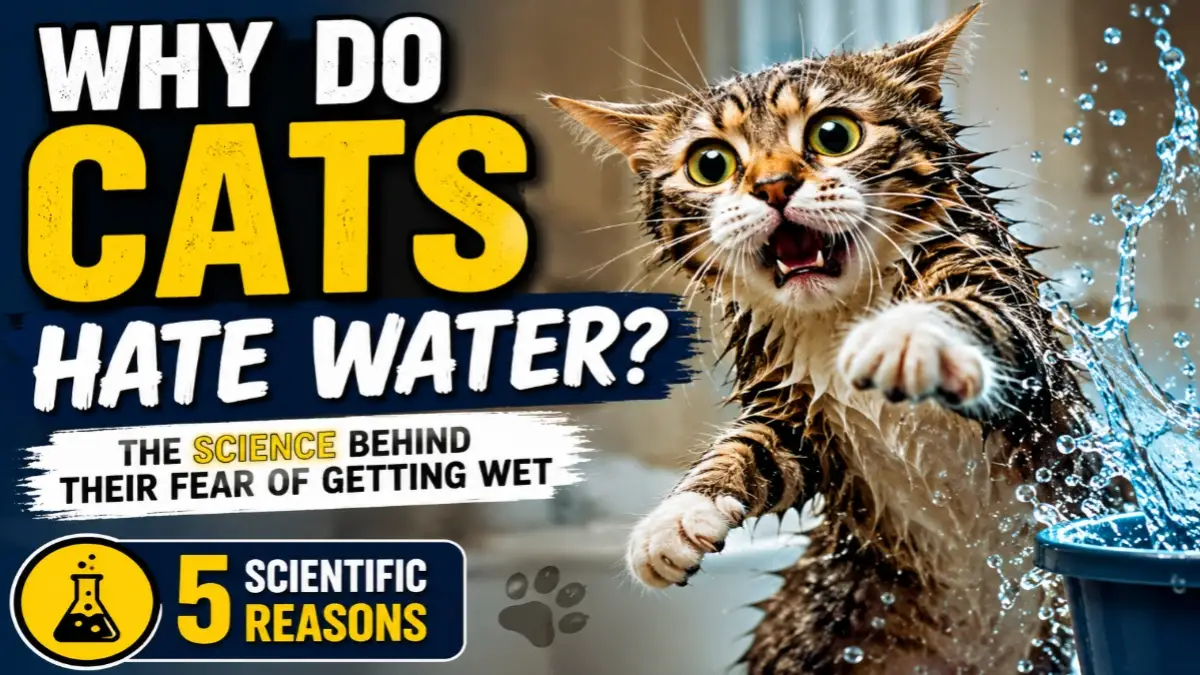

Most cat owners have witnessed the same dramatic reaction at least once.
A few drops of water land on a cat’s fur, and within seconds it jumps away, shakes its paws, or gives you a look that clearly says it wants nothing to do with water. While many dogs happily splash through puddles or swim in lakes, most cats prefer to keep their paws dry.
This raises an interesting question: why do cats hate water?
Contrary to popular belief, cats aren’t necessarily born with a fear of water itself. In fact, many cats are curious about dripping faucets, running sinks, and even rain falling outside the window. What most cats dislike is the feeling of having their fur soaked.
Veterinary behaviorists believe this reaction is influenced by a combination of evolution, body structure, survival instincts, and sensory sensitivity. For thousands of years, domestic cats developed in environments where avoiding unnecessary risks was essential for survival.
Understanding these natural instincts helps explain why water often feels uncomfortable rather than enjoyable for the average house cat.
Their Wild Ancestors Rarely Encountered Large Bodies of Water
One of the biggest reasons why do cats hate water comes from their evolutionary history.
Domestic cats are descended from the African wildcat (Felis lybica), a species that originally lived in dry grasslands and desert regions across North Africa and the Middle East.
Unlike animals that evolved around rivers, lakes, or wetlands, these wildcats had very little reason to swim or spend time in deep water.
Instead, they survived by hunting small prey in dry environments where agility, speed, and stealth were far more valuable than swimming ability.
Because water wasn’t an important part of their daily lives, there was never strong evolutionary pressure for cats to become comfortable with being soaked.
Over thousands of generations, domestic cats inherited many of these same survival instincts.
As a result, unfamiliar situations involving water often trigger caution rather than curiosity, especially when the cat cannot predict what will happen next.
Also Read: Why Does My Cat Bite Me Gently? Understanding Cat Love Bites and What They Really Mean
Wet Fur Makes Cats Feel Heavy and Vulnerable
Another major reason why do cats hate water has nothing to do with fear—it’s about how water changes the way their body feels.
A cat’s coat is designed to provide insulation and protect its skin. When that fur becomes completely soaked, it absorbs a surprising amount of water.
Unlike animals with coats that dry quickly, many domestic cats are left carrying extra weight until their fur dries.
For an animal that depends on speed, balance, and quick reflexes, this can be extremely uncomfortable.
A wet coat can:
- Reduce agility and jumping ability.
- Make movement feel slower and more difficult.
- Take a long time to dry.
- Leave the cat feeling exposed and uncomfortable.
From a survival perspective, losing mobility is a serious disadvantage.
Wild cats rely on rapid movements to escape predators and catch prey. If their fur becomes heavy with water, they may feel less capable of defending themselves or fleeing from danger.
This uncomfortable sensation is one of the strongest explanations for why do cats hate water. It’s not simply about getting wet—it’s about temporarily losing the speed and control their bodies are built for.
Cats Also Dislike the Sensation and Smell of Water
Cats experience the world very differently from humans.
Their sense of smell is far more sensitive, and they spend a significant part of each day grooming themselves to keep their coat clean and maintain their natural scent.
When a cat is suddenly soaked with water, especially tap water containing minerals or chlorine, that familiar scent changes instantly.
For many cats, this creates an unpleasant sensory experience.
At the same time, wet fur feels cold against the skin. Since cats have a slightly higher normal body temperature than humans, a soaked coat can make them feel chilled until they dry completely.
This combination of unfamiliar smells, damp fur, and physical discomfort is another important reason why do cats hate water.
Many cats immediately begin grooming after getting wet because they’re trying to:
- Restore their natural scent.
- Dry their fur as quickly as possible.
- Return to a clean and comfortable state.
It’s not unusual to see a cat spend several minutes licking its coat after only a small splash of water.
For cats, staying clean isn’t just about appearance—it’s an important part of feeling secure and in control of their environment.
Not Every Cat Hates Water
Although most domestic cats avoid getting wet, there are some interesting exceptions.
Certain cat breeds are naturally more comfortable around water than others, and some even enjoy playing in it.
For example:
- Turkish Van – Often called the “swimming cat,” this breed is famous for its unusual interest in water and has a coat that resists soaking.
- Maine Coon – Many Maine Coons enjoy splashing in water bowls or playing with running faucets thanks to their water-resistant fur.
- Bengal Cat – Because of their highly active and curious nature, Bengals are more likely to investigate sinks, showers, and shallow water than the average house cat.
Even among mixed-breed cats, personality plays a big role.
Some cats happily paw at dripping faucets, watch water flow from a tap, or sit near a shower without any fear. Others avoid even a few drops on their fur.
The key difference is that being curious about water isn’t the same as wanting to be completely wet.
Many cats enjoy observing or touching moving water but still dislike having their entire body soaked during a bath.
So while the stereotype that “all cats hate water” is common, the reality is more nuanced. Individual genetics, early experiences, breed characteristics, and personality all influence how a particular cat reacts to water.
Conclusion
So, why do cats hate water? The answer isn’t as simple as fear.
For most cats, avoiding water is a combination of evolutionary history, the uncomfortable feeling of a heavy wet coat, increased vulnerability, changes in body temperature, and their highly sensitive sense of smell.
These natural instincts helped their wild ancestors survive for thousands of years, and many domestic cats still display the same behaviors today.
It’s also important to remember that every cat is different. While many dislike baths, some breeds and individual cats enjoy playing with running water or even swimming.
If your cat needs a bath for medical or hygiene reasons, introduce water slowly, keep the experience as calm as possible, and never force unnecessary bathing.
Understanding the reason behind this behavior helps you respect your cat’s instincts and build a stronger, more trusting relationship.
Learn More About Cat Behavior and Water
If you’d like to explore more about feline behavior, grooming, and why some cats react differently to water, these trusted veterinary resources provide evidence-based information:
International Cat Care: https://icatcare.org
Cornell Feline Health Center: https://www.vet.cornell.edu/departments-centers-and-institutes/cornell-feline-health-center
American Association of Feline Practitioners (AAFP): https://catvets.com
FAQ
Why do most cats hate water?
Most cats dislike water because wet fur feels heavy, takes a long time to dry, and reduces their agility. Their desert-dwelling ancestors also had little exposure to large bodies of water, making this behavior part of their natural instincts.
Do all cats hate water?
No. While many domestic cats avoid getting wet, some breeds such as the Turkish Van, Maine Coon, and Bengal Cat are known to be more comfortable around water and may even enjoy playing in it.
Why do cats like running water but dislike baths?
Many cats are curious about moving water because it appears fresher and more interesting. However, they usually dislike baths because soaking their entire coat makes them feel heavy, cold, and uncomfortable.
Is it bad to bathe a cat?
Healthy cats generally keep themselves clean through grooming and do not require frequent baths. Bathe a cat only when necessary, such as for medical treatment, exposure to harmful substances, or severe dirt, and always use cat-safe products.
Can kittens learn to enjoy water?
Yes. If introduced gently and positively at an early age, some kittens may become more tolerant of water. However, every cat has a unique personality, so not all cats will enjoy getting wet.