
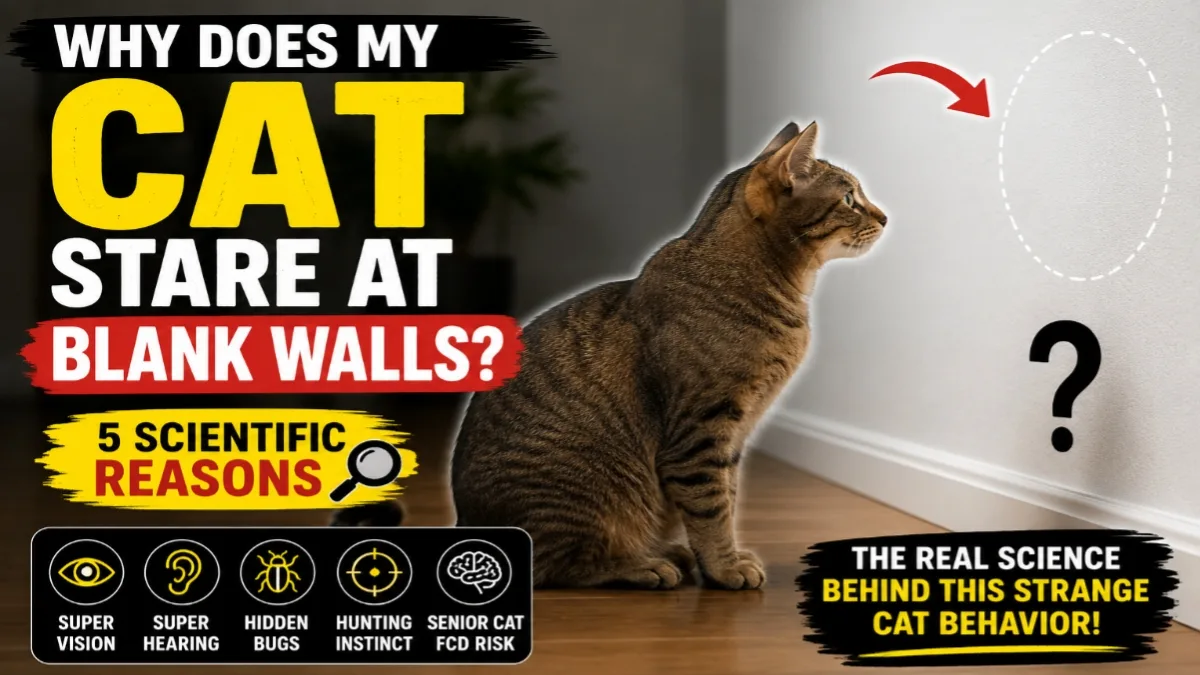

Have you ever caught your cat sitting quietly in the middle of the room, completely focused on a blank wall? There’s no toy, no insect, no moving shadow—yet your cat refuses to look away. Many cat owners experience this, especially late at night, and it often leads to the same question: Why does my cat stare at blank walls?
If you’ve searched online for why does my cat stare at blank walls, you’re not alone. Thousands of cat owners in the United States, Canada, and the UK notice this mysterious behavior and wonder if something unusual is happening. Some even joke that cats can see ghosts or invisible spirits.
The truth is much more fascinating.
According to feline psychology and veterinary experts, a cat staring at a blank wall is usually linked to its incredible senses rather than anything supernatural. Cats can detect tiny movements, hear sounds hidden inside walls, and notice light patterns that human eyes simply cannot see. In some cases, however, staring at walls can also point to an underlying health issue, especially in older cats.
In this guide, you’ll learn the real scientific reasons behind cat staring at wall behavior, when it’s perfectly normal, and when it may be time to contact your veterinarian.
Cats Can See Things Humans Simply Can’t
One of the biggest reasons behind why does my cat stare at blank walls is that your cat’s vision works very differently from yours. While a wall may look completely empty to you, your cat could be seeing movement, light reflections, or tiny details that your eyes completely miss.
Research suggests that cats are able to detect ultraviolet (UV) light far better than humans. Because of this, paint, wallpaper, fabrics, and even sunlight reflecting across a wall can appear completely different to them. What seems like an ordinary white wall may contain changing light patterns that easily grab your cat’s attention.
Cats are also incredibly sensitive to movement. Even a tiny dust particle floating through sunlight or the smallest insect crawling across the wall can trigger their hunting instincts. Their eyes are specially designed to notice motion, especially in dim lighting, making them natural hunters even inside your home.
So before assuming your cat is staring at “nothing,” remember that your cat may actually be watching a world your eyes simply cannot detect.
Also Read: Does Your Cat Trust You Completely? 13 Clear Signs Every Cat Parent Should Know
They May Be Listening to Sounds Hidden Inside the Walls
Sometimes your cat isn’t actually looking at the wall—they’re listening to it.
Cats have one of the most sensitive hearing systems in the animal kingdom. They can detect high-frequency sounds that are completely inaudible to humans. This extraordinary hearing allows them to notice tiny noises coming from inside walls, ceilings, or even beneath the floor.
If your cat suddenly freezes, points both ears toward a wall, and stares without moving, there’s a good chance they’ve heard something you can’t. In many homes, small insects, mice, squirrels, or even plumbing noises can create faint sounds hidden behind drywall or wooden panels. While these sounds go unnoticed by people, your cat treats them like potential prey.
This behavior becomes even more obvious at night. When the house is quiet and background noise disappears, cats can focus on the smallest scratching, tapping, or rustling sound. Their ears rotate independently to pinpoint the exact location, while their eyes remain locked on the spot where they believe the sound is coming from.
This is one reason why does my cat stare at blank walls is such a common question among cat owners. In reality, the wall may not be “blank” from your cat’s perspective at all. It could be hiding a fascinating world of tiny sounds that only your feline companion can hear.
If your cat occasionally stares at a wall with alert ears and a calm body, this behavior is usually a normal part of feline hunting instincts and doesn’t require any treatment.
Sometimes It’s Simply Your Cat’s Hunting Instinct Taking Over
Even the most pampered indoor cat still carries the instincts of a skilled predator. Thousands of years of evolution haven’t erased those natural hunting behaviors. That’s why a cat can suddenly become completely focused on one tiny spot for several minutes without making a sound.
When a cat suspects there might be movement nearby, it enters what animal behavior experts call “hunt mode.” During this time, its body becomes almost motionless, its pupils may widen, and every muscle stays ready to react. Even if the movement stops, the cat may continue staring at the same place because it’s waiting for the target to move again.
This explains why does my cat stare at blank walls even when you can’t see anything unusual. Your cat isn’t bored or confused—it’s patiently observing an area where it believes something could appear.
Indoor cats often display this behavior while watching walls, ceilings, windows, or closed doors. Sometimes they’re tracking a tiny insect. Other times they’re simply responding to faint vibrations or remembering where they previously noticed movement. Their brain is constantly processing information that humans would normally ignore.
However, context is important. If your cat occasionally stares at a wall and then quickly returns to normal activities, there’s usually nothing to worry about. But if the staring becomes frequent, lasts for long periods, or is accompanied by confusion, excessive vocalization, loss of balance, or unusual behavior, the cause may not be related to normal hunting instincts.
In senior cats especially, persistent wall staring can sometimes be linked to cognitive decline or certain medical conditions. Recognizing the difference between natural feline behavior and a potential health problem is essential for every responsible cat owner.
When Wall Staring Could Be a Medical Warning Sign
Although staring at walls is usually harmless, there are situations where it shouldn’t be ignored. If you’ve been wondering why does my cat stare at blank walls and the behavior has suddenly become frequent or unusual, it’s worth paying closer attention.
Older cats are more likely to develop a condition called Feline Cognitive Dysfunction (FCD), which is similar to dementia in humans. Cats with cognitive decline may appear confused, stare at walls for long periods, wander around the house at night, or seem unable to recognize familiar places. These changes usually develop gradually, making them easy to overlook at first.
Certain neurological conditions can also cause abnormal staring. In rare cases, seizures, vision problems, or high blood pressure may affect the way a cat responds to its surroundings. If your cat seems disoriented, walks into objects, loses balance, or keeps staring at walls while acting confused, a veterinary examination is recommended.
Pay attention to your cat’s overall body language instead of focusing only on the staring itself. A healthy cat that occasionally watches a wall with alert ears and relaxed posture is usually behaving normally. On the other hand, repeated wall staring combined with excessive meowing, appetite changes, hiding, or difficulty walking should never be ignored.
Quick Guide: Why Is Your Cat Staring at a Blank Wall?
| Behavior | Most Likely Reason |
|---|---|
| Watching the wall with ears pointed forward | Hearing insects or tiny sounds inside the wall |
| Staring at sunlight or bright reflections | Detecting UV light or tiny moving particles |
| Freezing and focusing on one spot | Natural hunting instinct |
| Long periods of staring with confusion in an older cat | Possible Feline Cognitive Dysfunction (FCD) |
| Staring along with balance problems or unusual behavior | Veterinary check-up recommended |
Conclusion
The next time you catch yourself asking, “Why does my cat stare at blank walls?”, remember that your cat experiences the world very differently than you do. Its powerful vision, extraordinary hearing, and natural hunting instincts allow it to detect things that remain completely invisible to human senses.
In most cases, this mysterious behavior is simply part of being a cat. However, if wall staring becomes frequent, is accompanied by confusion, or appears alongside other unusual symptoms, it’s best to consult your veterinarian to rule out any underlying health issues.
Understanding these small behaviors helps you become a more informed and confident cat owner—and strengthens the bond you share with your feline companion.
For more expert information about cat behavior, body language, and feline psychology, visit the International Cat Care guide
FAQ
Is it normal for my cat to stare at blank walls?
Yes. In most cases, it is completely normal. Cats have exceptional vision and hearing, allowing them to detect tiny movements, insects, light reflections, or sounds inside walls that humans cannot notice.
Can cats really see ghosts when they stare at a wall?
No scientific evidence suggests that cats can see ghosts or spirits. If you’re wondering why does my cat stare at blank walls, the explanation is usually related to their superior senses rather than anything paranormal.
Why does my cat stare at walls mostly at night?
Cats are naturally more active during the evening and nighttime. In a quiet house, they can hear tiny sounds from insects, rodents, or pipes much more clearly, which often causes them to stare at walls or ceilings.
When should I worry if my cat keeps staring at blank walls?
You should contact your veterinarian if wall staring is accompanied by confusion, loss of balance, excessive meowing, seizures, loss of appetite, or other unusual behavior, especially in older cats.
Can senior cats stare at walls because of a medical condition?
Yes. Older cats may develop Feline Cognitive Dysfunction (FCD), vision problems, or neurological disorders that can cause frequent wall staring. A veterinary examination is recommended if this behavior suddenly appears or becomes more frequent.